

Baldwin was key figure in the American civil rights movement of the last 1960s, and he is one of our most important American writers. Author of the novels If Beale Street Could Talk, Go Tell It on the Mountain, and Giovanni’s Room, he was also an essayist, poet, and playwright. Baldwin’s influence continues to grow, but even if you’ve never read a word James Baldwin has written – first, you should – you will find something to treasure in this conversation.
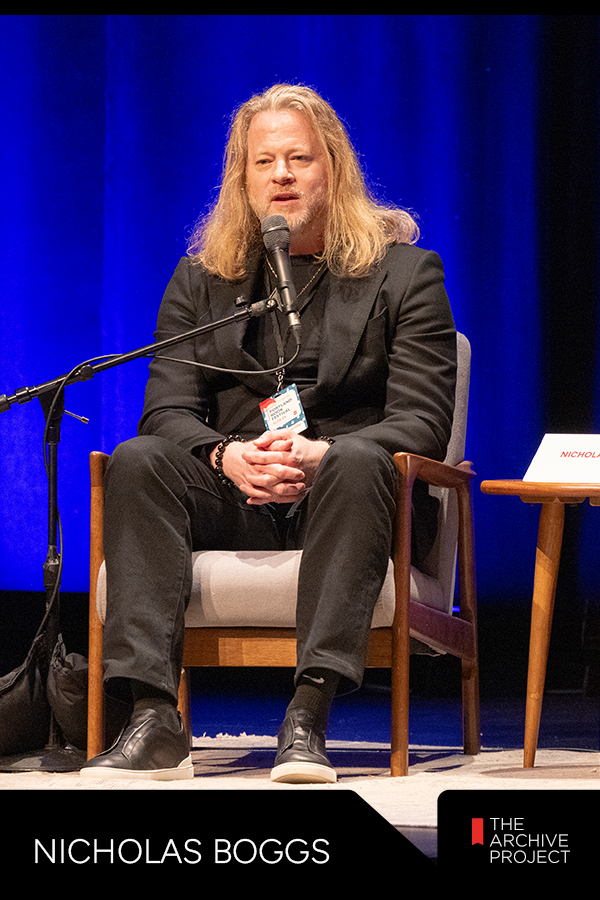
Boggs’s biography centers on the artistic and intimate relationships that informed Baldwin’s life and work. Douglas Brinkley, author of Rosa Parks: A Life, said “Nicholas Boggs’s meticulously researched and passionately written Baldwin is the crown jewel of the ongoing James Baldwin revival. … this epic biography captures Baldwin in full.”
Our interviewer is Mitchell S. Jackson, author of The Residue Years, Survival Math, and a Pulitzer Prize winning journalist. Jackson is one of the best interviewers — I genuinely think he should have his own talk show — and he brings so much care and curiosity to the conversation.
We start with a passage from the audiobook, which is published by Macmillan Audio and read by Ron Butler.
Nicholas Boggs is a writer and independent scholar, born and raised in Washington, DC, now living in Brooklyn, New York. He rediscovered and coedited a new edition of James Baldwin’s out-of-print collaboration with the French artist Yoran Cazac, Little Man, Little Man: A Story of Childhood (2018), and his writing has been anthologized in The Cambridge Companion to James Baldwin. He received his BA in English from Yale, his MFA in creative writing from American University, and his PhD in English from Columbia. Baldwin: A Love Story is Nicholas Boggs’ debut novel.
Mitchell S. Jackson is the winner of the 2021 Pulitzer Prize in Feature Writing and the 2021 National Magazine Award in Feature Writing. Jackson is the critically acclaimed author of The Residue Years, Survival Math: Notes on an All-American Family, Fly: The Big Book of Basketball Fashion, and John of Watts (to be published soon). His writing has been featured on the cover of the New York Times Book Review, Time, Esquire, and Marie Claire, as well as in The New Yorker, Harpers, The New York Times, and elsewhere. Jackson’s nonfiction book Survival Math was published in 2019 and named a best book of the year by fifteen publications, including NPR, Time, The Paris Review, The Root, Kirkus Reviews, and Buzzfeed. Jackson is a contributing writer for the New York Times Magazine, covers race and culture as the first Black columnist in the history of Esquire, and serves as the John O. Whiteman Dean’s Distinguished Professor in the English Department of Arizona State University.


