

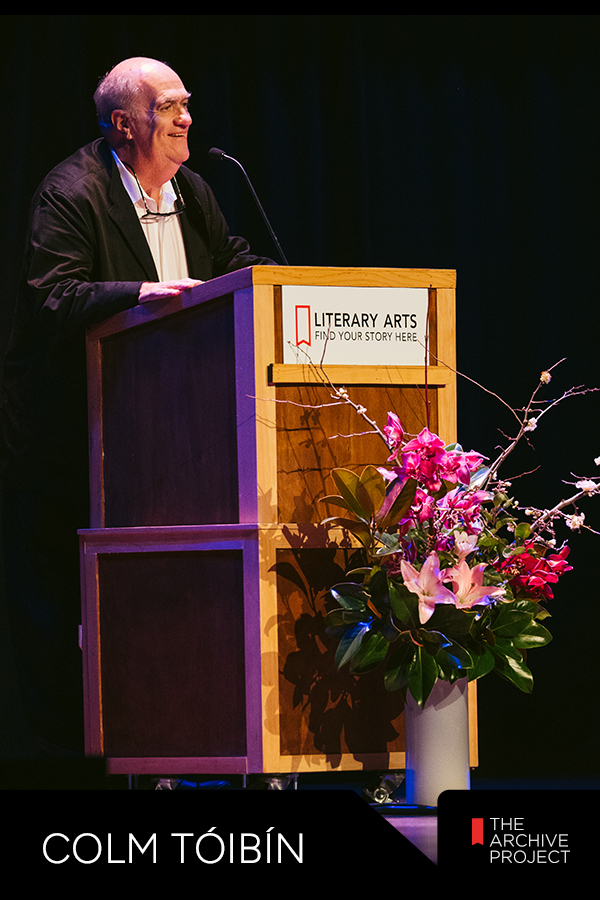
Colm Tóibín is the author of eleven novels, three short story collections and several works of nonfiction. He has written countless articles, plays, an opera libretto and a collection of poetry, and been a finalist for the Booker Prize multiple times
He is perhaps best known for his novel Brooklyn, which was made into a movie that was nominated for three Oscars. Set in the middle of the 20th century, Brooklyn is about Eilis Lacey who leaves her small town in Ireland for New York. After building a life there, she is drawn back home and has to choose where she wants to forge her future.
Tóibín opens his lecture with the moment of his father’s wake in his childhood home in which he hears, as a child, the real life story that would later inspire his character of Elis Lacey. From there, Tóibín’s talk is a captivating story of all of his stories, and a kind of master class for writing a novel. He is a writer known for rendering the quiet intimacies between characters, revealing powerful emotional undercurrents and their deep longings. He is a writer who makes you care about the tiny details of a life – the buttons on a coat or the emotional reverberations of a silence. In this talk, he illuminates his craft, and pulls the curtain back on how his own life shaped his most famous novels.
Colm Tóibín is the author of eleven novels, including Long Island, an Oprah’s Book Club Pick; The Magician, winner of the Rathbones Folio Prize; The Master, winner of the Los Angeles Times Book Prize; Brooklyn, winner of the Costa Book Award; and Nora Webster; as well as two story collections and several books of criticism. He is the Irene and Sidney B. Silverman Professor of the Humanities at Columbia University and was named the 2022–2024 Laureate for Irish Fiction by the Arts Council of Ireland. He was shortlisted three times for the Booker Prize. He was also awarded the Bodley Medal, the Würth Prize for European Literature, and the Prix Femina spécial for his body of work.


