
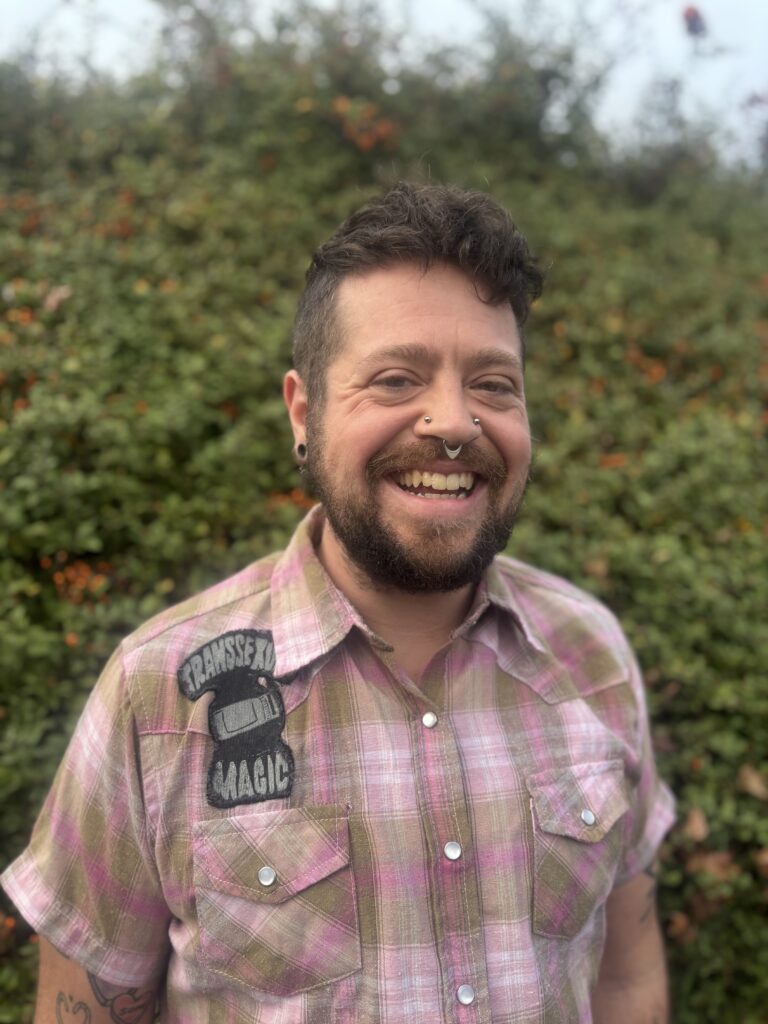
Originally from Louisiana, Brody Parrish Craig (they/them) is a queer southern writer who upheaves expectations to open spaces for connection, unlearning & change. They are the author of The Patient is an Unreliable Historian & Boyish, winner of the 2019 Omnidawn Poetry Chapbook Contest. They are editor of TWANG, a regional collection of trans, gender nonconforming & nonbinary creators tied to the south/Midwest. Their poems have appeared in Poetry Magazine, Muzzle Magazine, Mississippi Review, and beestung, amongst others. Find more on their work at brodyparrishcraig.com
For today’s Teacher Spotlight, we’re excited to introduce award-winning poet Brody Parrish Craig. As a recent addition to our teaching roster, Brody plans to teach two classes at Literary Arts this winter, Unreliable Historians: Reclaiming Truth & Agency in Narrative Writing and Feminist & Queer Approaches to Creative Writing. You can learn more about Brody in the short interview below, where we chatted with them about their interest in docupoetics, why writing sonnets can help you overcome writer’s block, and what students can expect to find in their upcoming classes.
Q & A WITH BRODY PARRISH CRAIG
Can you tell us about some of the upcoming classes you plan to teach? What are they all about and what do you hope students will take away from them?
I’m elated to teach a solo workshop (on January 24) on Unreliable Historians, inspired by my debut full-length poetry collection. In this workshop, we will investigate docupoetics and the role of language in agency—who gets to tell their story, and who determines who we get to hear and/or deem believable? While often familiar with the phrase unreliable narrator in writing, the term “unreliable historian” comes directly from medical chart notes & frequently dismisses the lived experience of disabled or mad individuals. This workshop will play with reclamation, struck-through text, black out poetry, and more!
If you’re into a longer class series, I’m also teaching a six-week workshop on feminist and queer creative writing in February-April. To be honest, this workshop is just my catch-all excuse to teach some of my favorite writers and thinkers, living and past, and get these authors/texts into the hands of others who may benefit from them. Growing up, I rarely had access to feminist/queer/trans stories, and this workshop first started by finding ways to bring examples (past and present) of these writers to youth who may not know their legacy/creative writing community is out there. For this series, we will share a few writings each week to discuss the authors, and have various prompts inspired by their work. The workshop itself is pretty open-ended—any genre or experience could participate, as the prompts will be structured to incorporate questions of identity, body, gender, and more broad concepts in our work than writing in one specific genre. I’m hoping to introduce folks to new favorite writers—old and new—that we can be in conversation with together as well as with each other when sharing our own written work!
Which writers, thinkers, or artists have had the most influence on your life as a writer?
Aimé Césaire, Diane di Prima, Essex Hemphill, and C.D. Wright immediately come to mind. Matt Henriksen, Tongo Eisen-Martin, and Canese Jarboe are some contemporary favorites that have influenced both my poetics and my praxis in terms of how I want to show up as a poet in the world today.
In your experience, what are some of the challenges and joys that are unique to writing poetry?
As a neuroqueer southerner, I often find that standard English or whatever you wanna call it feels limiting. I speak freely in association, and poetry lends to that—I feel like my brain is highly metaphorical, super fast, and super random. The leaps I make with sound and meaning are most easily embodied in poetry. Talking like this is way less interesting for me. Of course, it does take both ways in this world we live in, but writing sentences like this feels more like a loose translation of my thoughts than a weird rant of surrealist poetry does, which feels closer to the truth of the thing for me.
What’s the best writing advice you’ve received from another writer or teacher?
When you’re stuck, write a sonnet as fast as you can. Crazy for sure, and when Michael Heffernan said to do that, I totally thought he was insane. But turns out that’s exactly what I need and do most days or months when I get stuck. The formality of blank verse provides a sonic structure for the chaos that helps me jot something down. It’s like math, or a puzzle, that aids me. A freewrite with more parts.
When it comes to your own writing practice, what are some sources of creative inspiration for you right now?
I’m really inspired by music. Also, lots of creative nonfiction right now. Last year, I read a dozen or so memoirs on addiction, and these have been influential. I also love reading disability justice literature or books on madness. When I was writing my last book, I did a lot of research on the history of psychiatry, especially in the United States. I think that research/real world events really propel me. Oftentimes, music or research or current events are the inspiration for what’s next in my poetry.
QUESTION LIGHTNING ROUND
Current favorite poetry collection?
I just finished the anthology Heaven Looks Like Us: Palestinian Poetry edited by George Abraham and Noor Hindi this week, and the whole thing was so breathtaking. The range of voices, the styles, the poetics…I highly highly recommend this collection to anybody looking to feel the range of Palestinian poets writing today, but also just to anyone interested in contemporary poetry. I had so many favorites in this—every few pages I found myself stunned by a new writer’s observations and energy!
Your teaching style in 5 words?
Open. Fluid. Generative. Curious. Kind.
Favorite place to write?
Outside. I currently am writing this on my sunlit apartment balcony, one cat nuzzled beneath the porch chair, surrounded by string lights with my papaw’s old tin can bird feeder hanging above me…
Any forthcoming publications to shout out?
Not yet! I’ve got a new collection in the works, so stay tuned! Follow my more personal writer stuff at @brodyparrishcraig on Instagram or my website at brodyparrishcraig.com. In terms of writer things I’m looking forward to, I’m really excited to attend New Orleans Poetry Festival this April & read alongside so many cool queer/trans ecopoets for the festival on Friday! If you wind up that way, come see me!
Spots are still available in Brody’s classes! Follow the links below to find out more and register.
Unreliable Historians: Reclaiming Truth & Agency in Creative Writing (One-Day Workshop on Saturday, January 24, 2026)
Feminist & Queer Approaches to Creative Writing (Thursdays, February 26 – April 2, 2026)
Brody will also be a featured reader at Incite: Queer Writers Read on Wednesday, January 14.


