

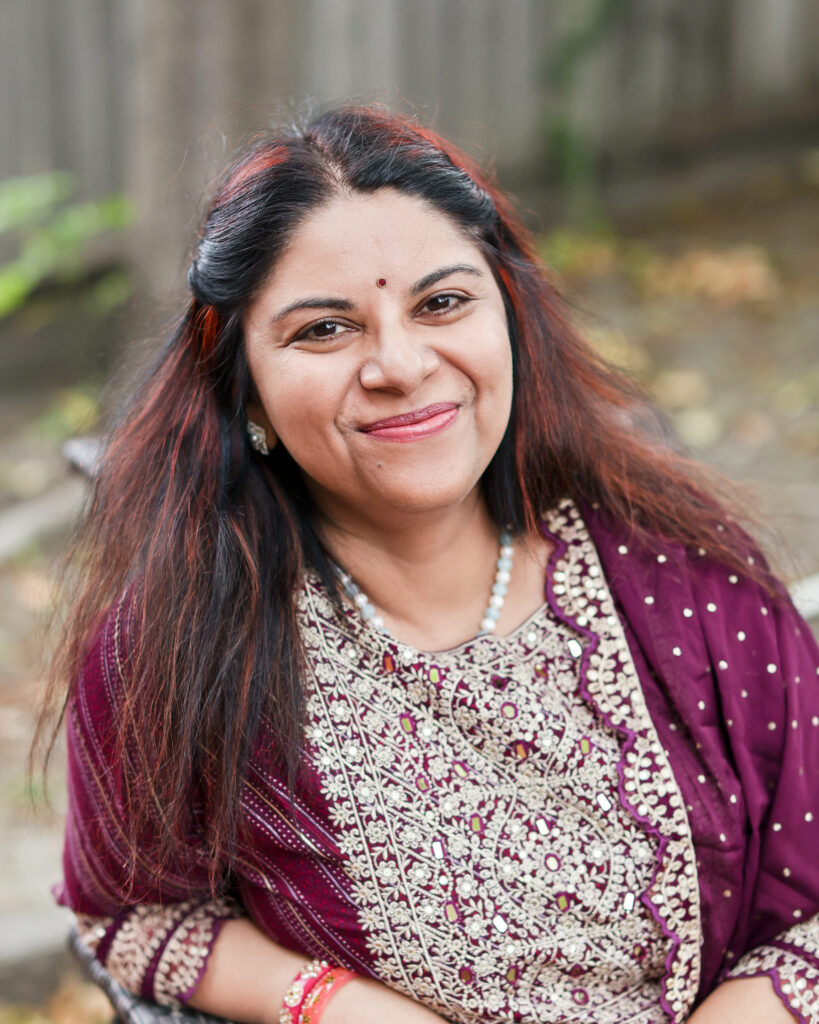
Radhika Sharma is the author of Parikrama, a collection of short stories and Mangoes for Monkeys, a novel. Radhika has been writing for over two decades and her byline has appeared in several publications including The San Francisco Chronicle, The San Jose Mercury News, India Currents, Tri City Voice and others. One of Radhika’s stories, “Just a Photograph”, was showcased by Kearny Street Workshop in APAture 2013: another story “Daddy Cool” was published by The Santa Clara Review.
As one of our long-time writing instructors at Literary Arts, Radhika Sharma brings warmth, enthusiasm, and multi-genre expertise to our online writing community. Her classes cover a wide range of offerings, from generative sessions on unlocking creativity to advanced memoir workshops to more specialized topics, such as her upcoming class on writing animals in fiction. With this fall edition of our Teacher Spotlight interview series, we are delighted to reintroduce Radhika to you today on the blog, particularly as we look forward to celebrating her soon-to-be-published debut poetry collection, Seasons of Sweetness.
INTERVIEW WITH RADHIKA SHARMA
LA: As a way of introducing yourself, can you share a little about how you came to teach for Literary Arts and the kinds of classes you teach?
RS: There are so many ways to answer this question! After a multi-disciplinary education in Life Sciences, Business Management, and an MFA in Creative Writing, teaching seemed like a natural progression of the journey. Literary non-profits are especially dear to me and when I reached out to the Director of Programs for Writers at Literary Arts, I was simply floored by her generous and kind response. A few interviews and discussions later, I was offered a class to teach. Since then, we have continued to develop more innovative programming for writers.
LA: Congratulations on your forthcoming debut poetry collection! What has this publication process been like?
RS: This slim poetry collection has been such a long time in the making! It is a work from the heart, like all my other books, both published and unpublished. Most of the poems in the book have been constructed in free verse and several kind readers and writing workshops have contributed to the book’s development. I come to poetry with humility and playfulness, which might not always be accessible when I am writing fiction, and so this collection has really been an experience in creative growth.
The publication process has been fantastic, and the team has been incredibly supportive, asking the right questions, nudging towards revisions, and still allowing the poet-author to retain creative control. I have no doubt that any future books of poetry I write will have a greater sophistication, nevertheless, the debut collection of anything is always the sweetest, just like baby steps towards anything and everything.
LA: I’d love to hear more about how you came to write this collection, as most of your previous publications have been in fiction. What were some of your sources of inspiration for this book and what do you hope people will take away from it?
RS: Excellent question! This book has magic dust! I have been working on multiple novels for so many years and that somehow seems to be the nature of my work in fiction—slow, laborious, with lots of essential research. I wrote this book of poems in moments of fatigue, in moments of playfulness, and in moments of attempting to access memory. As the reader will notice, this collection is an homage to my grandmothers and all the wonderful and exemplary women in my life. The thread of home and family is a common motif.
Most of the stories in my first short story collection, Parikrama, were created in response to the aesthetic of the MFA program I attended, and not necessarily a reflection my true intent as a storyteller and as a creative artist. My first novel, Mangoes for Monkeys, was a deeper and gentler creative writing experience. When I completed writing the final sentence for Mangoes for Monkeys, I knew I had become a novelist. Suchitra, the protagonist in the novel, remains one of my favorite characters in the world of the fictional story.
But to return to the question, poetry and intentional gratitude towards beauty and the joys of connection made the process of creating this book manuscript an exuberant, complex and deeply profound and intense experience. I am very happy to share this book with new readers and especially young readers, and all mothers and grandmothers!
LA: In your experience, how is writing poetry different from writing fiction, if at all? Are there consistent threads for you in the process across both genres?
RS: This is such a complex question! In both forms, there is a unity in the core ideas of sentence construction and the ebb and flow of an image on the page. Yet, writing fiction is like a marathon; there is simply no short-circuiting the process. If any writer is embarking on the journey to write a novel, be prepared to fortify yourself. It will be a long, confounding, frustrating journey with several stops on the path, yet there remains the glimmer of the story that beckons the writer to keep constructing moment after moment, scene after scene on the page.
The poem, although deceptively smaller in form, is pretty much the same experience: shaping a sentence that offers a fragment of the slice of life that is reverberating in the poet’s mind. In brief, both forms reach towards creating on the page, and an effort to place in words the experience of being alive. Like all efforts in language, the idea of expression is designed to fail, in the sense that words will always fall short of feeling. The poem is just like a firefly glowing in the dark. Brief, beautiful and incandescent. Reverent and irreverent, all at once.
LA: What advice do you have for writers who are interested in exploring a different genre than the one they’re used to?
RS: My advice is simply to not listen to any advice, including the advice of their own doubting minds. On a more pragmatic note, creative exploration and form-shifting is not a “good-to-have” in the writer’s toolkit. It is a “must-have.” When your path in one form becomes mossy and slippery, as it will in time in the creative journey, the process of creative exploration is your support and North Star.
LA: As a teaching artist, you get to work with writers at all stages of their creative processes. What do you find most rewarding or exciting about teaching and how does it inform your own work as a writer?
RS: I absolutely adore the writers I work with! They are generous, sweet, kind and sometimes a little too ambitious for the moment—all great qualities for any creative person to possess. So many of my former students return often to share thoughts about their publication journey and milestones. Many of them become peers at the close of the quarter or at the final moment in the writing workshop. My students send me book recommendations and offer questions that make me do a double-take and reexamine hallowed ideas in teaching. Teaching has been the biggest privilege of my writing career, or not a “career” as much as it is the air I breathe, and my student-writers—a bridge to the future of creative innovation.
LA: Thanks for taking the time share your thoughts with us, Radhika. On a closing note, how would you describe your teaching style in five words or less?
RS: This question is both easy and difficult at the same time! Five words? As a teacher I simply: love, light, nurture, nudge, and believe in my students’ boundless capacity for creative excellence.
Thank you for the opportunity to share my creative intent and philosophy. See you in the classroom! Write forward.
Radhika’s poetry collection Seasons of Sweetness is forthcoming in October, 2026. You can learn more about Radhika’s publications on her website here.
If you’d like to register for or learn more about Radhika’s upcoming online fall class, click on the link below:
Writing Animals – Starts October 28 (online via Zoom)


