

We’re thrilled to introduce the 2026 Oregon Literary Fellowship recipients with individual profile features on our blog. Out-of-state judges spent several months evaluating the 400+ applications we received, and selected eight writers and two publishers to receive grants of $4,000 each. Literary Arts also awarded two Oregon Literary Career Fellowships of $10,000 each. The 2026 Fellowship recipients were recognized at the 2026 Oregon Book Awards Ceremony on April 20 and a public reading event on June 29 at the Literary Arts Bookstore.
Follow along as we roll out profiles of this year’s Fellows throughout the summer to learn more about some of the most exciting writers at work today in Oregon. And if you feel inspired after reading, consider applying for a 2027 Oregon Literary Fellowship yourself—applications are now open and will close on August 7, 2026.
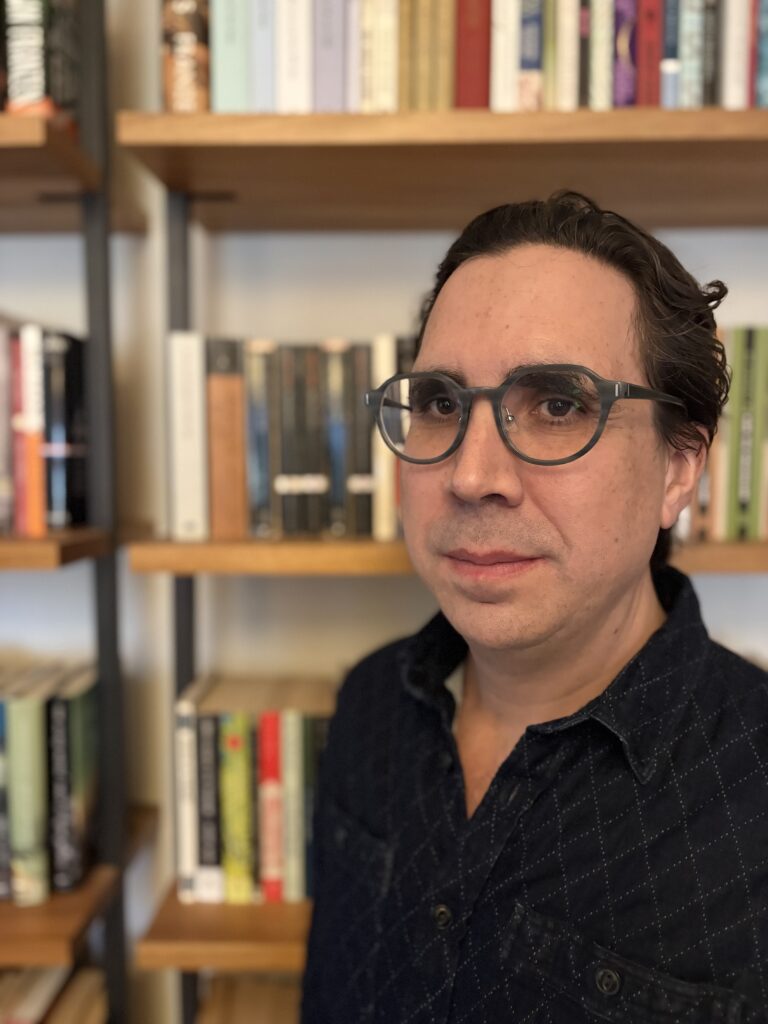
Casey Walker is a 2026 Oregon Literary Fellow in Fiction and the winner of a Laurell Swails and Donald Monroe Memorial Fellowship. Casey is the author of the novel Last Days in Shanghai (Counterpoint Press) and a graduate of the Iowa Writers’ Workshop. He holds a PhD in English Literature from Princeton University. His fiction and essays have appeared in The Believer, The Common, Boston Review, The New York Times, and El País, among others. He grew up in a small desert town on the California-Mexico border, which serves as the setting of his novel-in-progress, MEXICALI.
Q & A WITH LITERARY ARTS
What excites you the most about receiving an Oregon Literary Fellowship?
My first thought is that I’m excited to not have to apply again, to track the deadline, to wait and hope and wonder. The public side of writing is, very often, discouraging if not outright embarrassing. The not-awarded fellowship, the un-attended writing residency, the rejected panel discussion, the workshop story no one likes, the reading full of empty chairs. Even writers I know with excellent careers and wonderful publication histories go through this.
I grew up in a desert, so I often tell myself, and tell students, when I teach, that for the public side of a writing life you have to live like a cactus. Soak it up when the rain comes, and hold onto it, because it might be a while until the next one. So that brings me to my real answer: what excites me most about receiving an Oregon Literary Fellowship is soaking in a little rain.
How would you describe your writing process or creative practice?
A long time ago I heard a writer—I don’t remember who, now—compare her writing process to being a small shopkeeper. You come in, lift the metal grate, flick on the lights, turn around the open sign. And then you wait. Sometimes it’s a slow day, no customers, no money coming in, and you close up shop. Other days it’s so busy you barely have time to think, you’re just so in the flow of the work. That’s basically what I do. I keep regular hours. I open the store most days. Usually something happens. Sometimes nothing happens. But I think a lot more about process than about product. Showing up and turning the lights on is the most important.
What authors or books have shaped you the most as a writer?
At every age of my life, I’ve had authors I loved who were some of my closest companions of that time—as a kid, it would have been things I found at the public library, The Great Brain books and the Hardy Boys. When I was in high school it was books by Hermann Hesse and Jack Kerouac. By college, it was Virginia Woolf, and Woolf was the gateway into Marcel Proust, and after that I went backwards into Henry James. At one point, I went through a phase where I read every Raymond Chandler novel and then right after that I read Rachel Cusk’s Outline trilogy. This is probably my favorite thing about the novel as a genre, how absolutely capacious it is. It can accommodate so many styles, lives, stories. I just read Lonesome Dove, and fell completely in love with it, and then read Ben Lerner’s Transcription—they couldn’t be more different, and yet I was completely under the spell of each one.
Are there any Oregon writers you look to for motivation or inspiration?
When I first moved here, almost ten years ago now, I read Patrick DeWitt’s The Sisters Brothers and I thought, yes, okay, great, I’m going to be fine here. More recently, I’ve been reading a book by Lisa Wells, The Fire Passage, which was nominated for the Oregon Book Award in Poetry this year. It’s really wonderful, and I’ve been walking around with a lot of her lines in my head: “We think the transformation beautiful/but it’s loud inside the chrysalis.”
What writing projects are you working on right now?
At the moment, I’m working with my editor on the last draft of a novel called MEXICALI that will be published by Knopf in late 2027. It’s a novel that I’ve worked on for more than a decade, a portrait of the desert border towns I grew up in, right at the moment those towns were coming into being in the early 20th century. It’s a long book, and takes in a whole history of borderland vice and the Mexican Revolution and American Prohibition and the research was just fascinating to me. Every thread I pulled on seemed to explain to me even more deeply this place I’m from and the history of the U.S.-Mexico border. I’ll be so excited to finally see the book between covers and share it with readers.
Do you have any advice for future applicants?
Set a calendar reminder for that mid-summer deadline. It always sneaks up on you. Also, of course, keep applying. Most of the recipients I’ve met over the years applied many times before they were awarded a fellowship. Keep going. Live like a cactus.
WRITING SAMPLE EXCERPT
[…]
After Grace died, I began to set things in order. I felt like the last curator of a lost civilization, cataloging the contents of Odd’s desk—scrip tokens from the Owl Cabaret, once redeemable for roulette or whiskey or a woman upstairs; a Bisley Colt pistol, unloaded; a Kodachrome photograph of Odd standing on a mountainside outside of Tecate, squinting into the sunlight with an unknown woman beside him brandishing a gun. Grace kept the diaries of her twin brother, Solon, which she’d told me existed, but had never let me read. Solon was dead before I was born, and Grace was always prickly and evasive whenever I asked about him, as though the secrets of the dead should be passed over in silence. But the fact that she’d kept her brother’s diaries, rather than burning them, made me wonder if she did actually wish to preserve their contents for the world to come.
The bottom drawer of Odd’s desk was a struggle to pry open. It took me crawling under the desk to jam the drawer free. Once I had the drawer out, I saw the impediment—what looked to be a solid wood block at the back was, in fact, a false panel. The panel concealed a small box, and inside that box was a glass-fronted wooden case, the kind of thing I’ve seen in cathedrals, holding the relic of a saint. This case contained a dark leathery object that was hard to see through the dusty glass. I assumed it had once lived in a church or a museum, because on its front was a brass nameplate with three words and a date: Soldadera. Corazon. Sonora 1915.
I wiped the reliquary glass clean. It took several minutes of staring to comprehend what I was holding. It was, in fact, a human heart. The heart was a black lump the size of a fist, with little left to indicate it was once a part of something living. Grace was a shrewd woman, and she’d kept secrets, but she was not alive any longer to tell me what she knew about this heart’s existence, if she knew, or who it belonged to.
So as far as that question goes—who was Odd Slade?—I can say he was a man who kept in his possession a withered human heart. If the following testimony is too kind to him, or too cruel, it is intended at least to address him as he was.
JUDGE’S CITATION
“Casey Walker’s work carries the latent violence of the desert as well as its richness and forgotten histories. It invites readers to pull up a chair and spend a hundred years in an inflamed corner of the country. With generational scope and biting precision, it offers the story of Odd Slade and family but more, too—through its telling, we are made the gift of a land and its people.”
—Raghav Rao


