
We’re thrilled to introduce the 2026 Oregon Literary Fellowship recipients with individual profile features on our blog. Out-of-state judges spent several months evaluating the 400+ applications we received, and selected eight writers and two publishers to receive grants of $4,000 each. Literary Arts also awarded two Oregon Literary Career Fellowships of $10,000 each. The 2026 Fellowship recipients were recognized at the 2026 Oregon Book Awards Ceremony on April 20, and a public reading event featuring this year’s Fellows will take place on Monday, June 29 at the Literary Arts Bookstore.
Follow along as we roll out profiles of this year’s Fellows throughout the summer to learn more about some of the most exciting writers at work today in Oregon. And if you feel inspired after reading, consider applying for a 2027 Oregon Literary Fellowship yourself—applications are now open and will close on August 7, 2026.
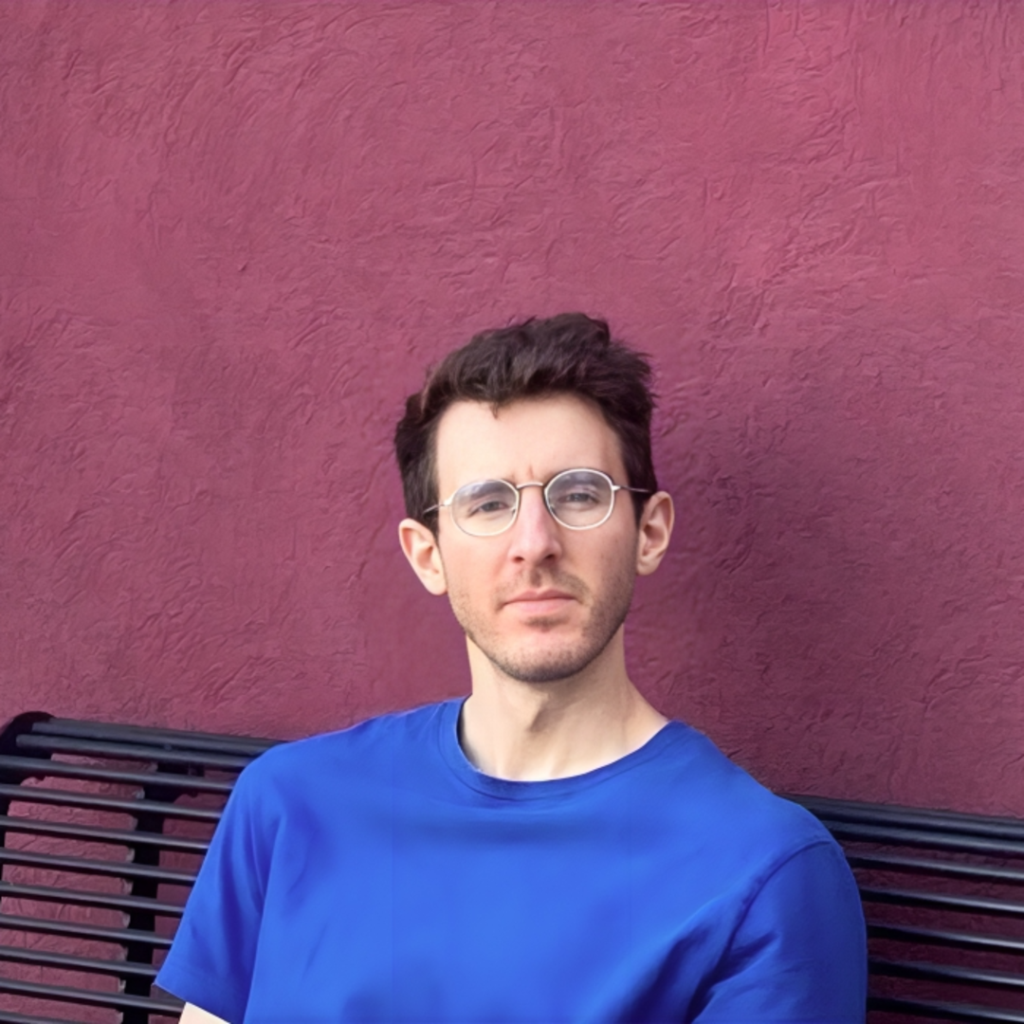
Jeremy Klemin is a 2026 Oregon Literary Fellow and the recipient of the Leslie Bradshaw Fellowship. His writing and literary translations appear in AGNI, The Atlantic, The Kenyon Review, The New Republic, The New York Times, and elsewhere. His work has received support from the Fulbright Program, Disquiet International, and the Bread Loaf Writers’ Conference. He holds an MFA in nonfiction writing from Oregon State University, and is working on an essay collection about skateboarding, disability, and public space.
Q & A WITH LITERARY ARTS
What excites you the most about receiving an Oregon Literary Fellowship?
The sense of community it provides, above all. I’ve lived in Oregon for over four years now, much longer than anywhere else I’ve lived since graduating college. I felt a little weird about being an “Oregon” writer, given that so much of my place-based work is about elsewhere. But receiving this fellowship helps solidify the feeling that I’ve found my writing home—I’m lucky to be surrounded by such a vibrant literary scene.
How would you describe your writing process or creative practice?
Most of my work starts with something unresolved, whether in my personal life or otherwise. A dispute in which both sides have legitimate gripes. A question about fairness or access, and the limits of fairness. If I think there’s more to a given situation, I read about it, talk to people, scribble, and then start moving around those scribbles on a blank page. Often I’ll hit a dead end, but when I don’t, it’s an exciting feeling.
What authors or books have shaped you the most as a writer?
Ooo. On the nonfiction side: Teju Cole’s Known and Strange Things, as my gateway into the literary essay. Brian Blanchfield’s Proxies for its erudition and honesty. Kyle Beachy’s The Most Fun Thing, a 2021 essay collection that I think helped to spark a recent renaissance of serious writing about skateboarding. Sarah Gerard’s Sunshine State, a really incredible and ambitious Florida-based collection of essays.
On the fiction side: Gerald Murnane’s The Plains for its incredible sense of place and bizarre sensibility. All of Rachel Cusk’s work: whenever I’m in a reading slump, I’ll return to her. Mavis Gallant’s Varieties of Exile for its attention to language. John Keene’s Counternarratives. Each time I’ve tried to write fiction, it has ended up as a bad John Keene impersonation.
Are there any Oregon writers you look to for motivation or inspiration?
Oh, definitely. Justin Hocking’s The Great Floodgates of the Wonderworld was a big inspiration for the current project I’m working on. Paige Thomas, a multi-genre artist whose razor-sharp Person Under came out this year. And Steven Moore: a fantastic and hilarious essayist whose work I return to whenever I’m bogged down at the sentence level. I highly recommend his collection The Distance from Slaughter County.
My mentors from the Oregon State MFA program, too: Elena Passarello, George Estreich, and Justin St. Germain. All great writers, and even better people.
What writing projects are you working on right now?
I just finished a short translation of a flash piece by the Portuguese writer António Lobo Antunes. Part of the beauty of translating is that you can work on it while avoiding the writing, and vice versa. The larger piece that I was avoiding is about the wheelchair van economy. I’m not totally sure what its final shape will be, but it continues to have my attention.
Otherwise, I’m revising a few pieces from my in-progress essay collection: cutting the things, killing the darlings.
Do you have any advice for future applicants?
Be faithful to your interests! If you can’t stop thinking about something, write about it.
WRITING SAMPLE EXCERPT
Excerpt from the Introduction to Jeremy Klemin’s book-in-progress Hall of Meat, originally published in full as an essay in the New York Times.
Introduction
Almost 20 years ago, I accompanied my mom on her first visit to the nonemergency wing of the Los Alamitos Medical Center in California. I was 14 at the time, obsessed with skateboarding. Mom, who has cerebral palsy, used a walker back then and decided to give the accessible entrance a try. It was a gently ascending switchback ramp, roughly 80 feet long. The ramp was ideal for wheelchair users, but its length and 180-degree turn made it difficult for my mom. She was winded by the time she got to the door and had to sit on a nearby bench to rest before continuing. Even on her best days, switchbacks exhausted her.
The next time we went, she tried the stairs—six brick steps accompanied by a handrail made of two parallel varnished planks of wood. As usual, I would walk behind her, there to steady her if she momentarily lost balance. I remember the wooden handrail because it deviated from the standard circular metal bars. It’s possible that it met accessibility standards set out in the Americans with Disabilities Act of 1990, but even so, it was impractical for my mom. Accessibility is partly about meeting architectural code, but it involves so much more: individuals, their changing bodies, the multiple ways to get from here to there.
I also remember the handrail because I thought it might be the first one I’d grind on my skateboard. I would perform a jump, an “ollie,” and the bottom of my board would lock onto the rail, at which point I’d slide down and land on the concrete below. It appeared doable: As I trailed my mom up the stairs, I saw the vibrant, technicolor streaks on the rail that indicated someone else had already tried.
I never did try that rail. The brick upper landing made for a bumpy, unpleasant run-up, and there was something about trying a dangerous trick at a hospital that felt a bit too on the nose. But those trips with my mom made obvious for me something I’d always known implicitly: that both skateboarding and navigating daily life with a disability involve surprisingly similar ways of engaging with the built environment.
I had experiences like this with my dad, too, who also had cerebral palsy before passing away of a heart attack in 2023. When my parents divorced and he moved back to my grandparents’ house in East Long Beach, he and I would sometimes roll out to the nearby 7-Eleven together for a Slurpee—he in his push wheelchair and me a few paces ahead on my Zero brand skateboard. But roots from nearby trees were strong enough to upend the sidewalk, creating massive cracks that even the biggest of wheels couldn’t glide over, and we’d have to detour to the street. It wasn’t all frustration, though: At the same house, the wooden ramp that my father placed over the three-stair entrance was also perfect for modest kickturns and kickflips. I’d gather some speed, roll up most of the ramp, and then flip my board counterclockwise, riding back down in the “fakie” stance.
In her 2020 book, “What Can a Body Do?”, the artist and design researcher Sara Hendren convincingly argues that disability is fertile ground for creativity: Spaces that are inaccessible are indicative of failures in design rather than the human body, and those failures require creative solutions. It is an idea that is expressed daily by people like my parents.
Of course, central to all these activities are wheels and ramps. Hendren emphasized this point when, more than a decade ago, she designed a ramp that could be used by either wheelchair users or skateboarders. In an interview in Psychology Today, Ms. Hendren explained that her goal was to create “a weird Venn diagram” between skateboarding and wheelchair use “because people never think of those two things together.” The skaters, she explained, were seen as executing “this rebellious, athletically virtuosic thing,” while wheelchair users were seen as engaging in “a kind of sad version of not walking.” Her ramp was a way of saying they might be seen together, sharing the same pragmatic physics of the inclined plane.
When I went out with my parents and we encountered obstacles, we bonded over the shared need to find solutions. We approached the built environment as though it were a puzzle video game—if we could just put the right pieces in the right order, the solution would be revealed to us. (Sometimes there was no solution.) I recently asked my mom whether she thought my skateboarder’s vision and her vision as a person with a disability had anything in common. “You could look at a staircase and say, ‘I can do this one,’” she said, “in the same way that I can look at something and tell you exactly whether I’m going to have trouble with it.” In time, navigating the world with my parents helped me grow as a thinker and problem-solver: I learned that sometimes the best solution is an imperfect one, and that few things matter more than the ability to think in the moment, to improvise.
JUDGE’S CITATION
“Jeremy Klemin’s nonfiction masterfully destabilizes the built environment—hacking its codes and parsing its rhetorics while reveling in architecture’s transformative potential. Whether writing about skateboarding or theme parks, Klemin pays exacting attention to the surfaces upon which public life unfolds, and to the people who must continually reimagine these spaces in order to live. To move through space differently is, in Klemin’s work, an issue of ability and ableism, but also creativity and joy.”
—Thomas Dai
Applications for the 2027 Oregon Literary Fellowships are now open. The deadline to apply is Friday, August 7, 2026.


